
Rav Avrohom Mordechai Alter zt"l
הרב אברהם מרדכי בן אריה יהודה לייב אלתר זצ"ל
Sivan 6 , 5708
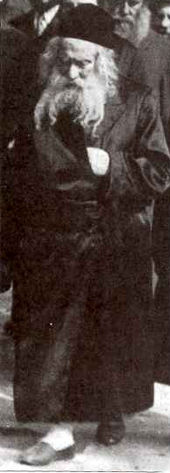
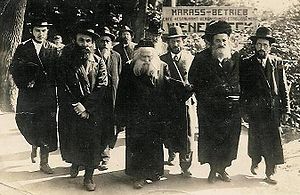
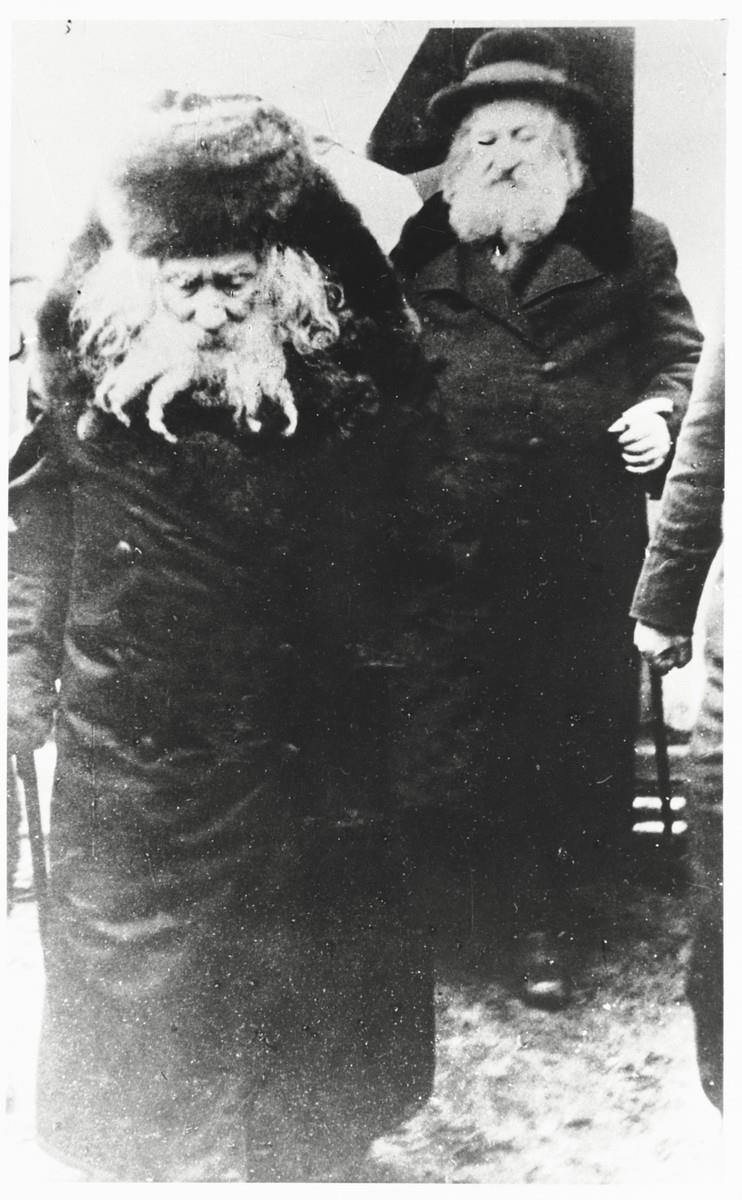

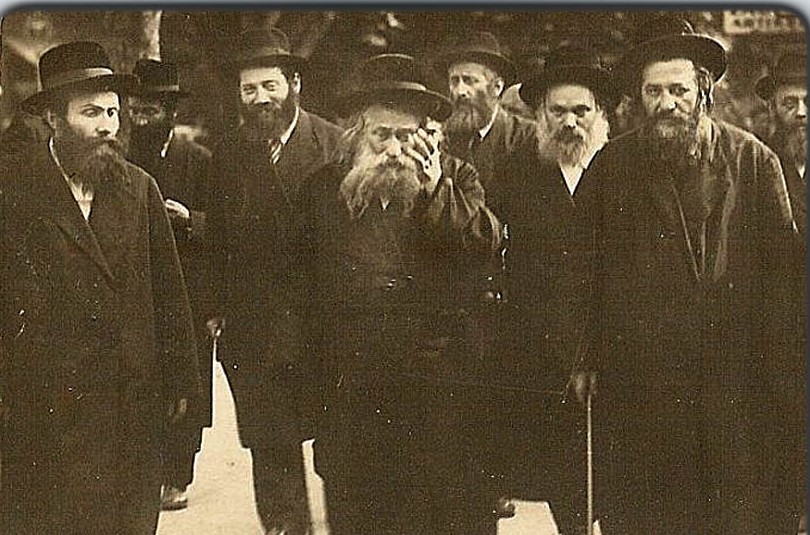
Rav Avrohom Mordechai Alter zt"l
Rabbi Avraham Mordechai Alter (1866 - 6 Sivan 1948), the son of the Sfas Emes, was the third Rebbe in the Gur dynasty. A position he held from 1905 until his death in 1948. He was the spiritual leader of over 250,000 Chassidim in pre-WW II Poland. In 1940, he managed to escape with three of his sons to Eretz Yisrael (then Palestine), although the vast majority of his followers did not survive. He was on of the founders of the Agudas Yisroel in Poland. He began to rebuild the Gerrer community in Yerushalayim, but he died there during the siege of Yerushalayim on Shavuos, 1948. He was known as the Imrei Emes, after the title of his major book.
http://www.ascentofsafed.com/cgi-bin/ascent.cgi?Name=rebbeBios
Stories of Rav Avrohom Mordechai Alter zt"l

In 1923, the Chofetz Chaim zt"l traveled to Vienna to participate in the Agudas Yisroel convention, and he spent some time together with R' Avraham Mordechai Alter zt"l, the Gerrer Rebbe. In the course of their discussion, the Chofetz Chaim cited the verse from that week's parsha (Devorim 13:5):אחרי ה' אלקיכם תלכו ואתו תיראו ואת מצותיו תשמרו ובקלו תשמעו ואתו תעבדו ובו תדבקון:
"Acharei [literally, 'after'] Hashem, your God, shall you follow and Him shall you fear; His commandments shall you observe and to His voice shall you hearken; Him shall you serve and to Him shall you cleave." The Chofetz Chaim commented:
"Our Sages observe that the Torah uses two words for 'after' - 'Acharei,' which means 'long after' (or 'far away') and 'achar,' which means 'soon after' (or 'close'). Why does our verse use 'acharei,' implying that one should follow Hashem from a distance? In fact, one should become as close to God as possible!" He explained: Sometimes a person becomes depressed, and he feels that he is standing on the brink of a cliff as far from God as can be. He is confident that Hashem will not help him at this moment. One should know that such feelings are the work of the yetzer hora. Hashem is a Jew's "Father" at all times, and He accepts His children when they return to Him and saves them from all troubles. Even when one is "acharei," "far away," he should not despair of following Hashem. This is the meaning of the words in the High Holiday prayers, "Fortunate is the man who will not forget You, and the human being who will find strength in You."
The Gerrer Rebbe responded: "Now I will try to interpret this verse in the manner of the Chassidim. Specifically when a person feels distant from Hashem, that is when he can best follow Hashem, as it is written in Tehilim: 'God is close to the broken-hearted'." Otzrosaihem Shel Tzaddikim https://www.shemayisrael.com/parsha/parkoff/archives/lagbaomer76.htm
Rav Avrohom Mordechai Alter of Warsaw was the Chiddushei HaRim’s eldest child, and, like all the other children of Rav Yitzchok Meir of Ger, he was unwell. The Chiddushei HaRim had lost all his other children and now Rav Avrohom Mordechai, just thirty years old, was sick again; death was calling at his door and it looked like he would succumb and leave the world with no son as his heir. The doctors had given up hope, and it seemed like Rav Avrohom Mordechai was already in the final throes of death, when his childhood friend, Rav Yaakov Arye of Radzimin, leaned over and whispered in his ear, “I have one piece of advice left for you, my dear friend: ask Hashem to grant you life, long enough to merit having a son you don’t yet have!”
The Chiddushei HaRim also approached the sickbed and told his dying son, “You must know that it is a mitzva to desire to live, as it says, ‘Choose life – uvocharta vachaim!’ Please, my son, strengthen yourself – choose life and get well!”
Rav Avrohom Mordechai strengthened himself and with Herculean effort and his last strength, he sat up and cried out, “Ribbono Shel Olam, please grant me the gift of life so that I can have a son – I shall name him Yehuda, as it says, ‘This time – odeh es Hashem – I shall thank G-d!”
A miracle occurred and Rav Avrohom Mordechai recovered! The next year, he did indeed have a son, and with Rav Chaim Meir Yechiel, the Seraph of Mogolintza, as his sandak, the baby was brought into the bris of Avrohom Avinu and named “Yehudah Leib” as promised! Rav Avrohom Mordechai told his wife, Esther, “I named him Yehuda and he will cause all the hearts of Klal Yisrael to praise and give thanks – lehodos LaShem!” The Sefas Emes used to say about himself, “My father named me Yehuda, which means “thanksgiving”, because he was healed from his sickness in my merit, and I feel this within me as well; each day and night I never tire of ceaselessly giving thanks – lehodos LaShem!” (Marbitzei Torah BeOlam HaChassidus, Vol, II p. 83–84)
Divrei Torah of Rav Avrohom Mordechai Alter zt"l
the beggars purse
The king sighed a heavily. What was to be done with his son, the prince? The young man simply had no regard for money, and he spent it like water. He wasted money on lavish balls and affairs, fancy clothes, vain pursuits, gambling, and any sport he wished. He kept running up debts until the king could no longer ignore the prince’s reckless, frivolous lifestyle.
“I have no other choice,” the king said to himself as he shook his head, and resolved to punish the prince in order to teach him the value of money and responsibility.
The prince hung his head in shame as the king spoke. “You are hereby banished from the palace. You may not take anything with you but the clothes on your back--maybe then you will learn to value hard work and money!”
The prince made his way to town. There, he found that none of his former “friends” wanted anything to do with him now that he was penniless. Eventually, he took to begging along with the rest of the paupers and made his home among the hovels of the destitute.
It was to this slum that the king’s magistrate made his way many years later in search of the prince. He was sent by the king on a mission of reconciliation. His Majesty had decided that enough was enough; by now, surely his son had learned his lesson. The official searched for the prince in all sectors of the town until he was finally told to look among the hovels of the poor. It was there that he discovered the prince.
“My dear prince – your father, the king, has sent me to find you,” the magistrate said as he pinched his nose with fine silk gloves to fend off the malodors of the wretched shack. Dressed in tattered rags the nearly unrecognizable, the prince looked up. His eye, which had dulled from years of hardship and despair, now gleamed with hope.
“My…my father? His Majesty the king?” His voice shook with emotion as he struggled to remember his father and his former station in a previous life.
“Yes,” the magistrate declared. “His Majesty sent me to locate you, and so I have done. Now I have been sent to ask you if there is anything – anything at all – that you wish and need?”
“What? What did you say? Anything?” asked the startled pauper-prince.
“Yes,” smiled the magistrate. “Anything at all.” Surely, he thought, the prince would ask for permission to come out of exile – and then the magistrate would bring him new clothes, a washup and a coach to deliver him back home. But the magistrate was shocked by the pauper prince’s answer.
“Wow! What a great father! Anything at all, you say? Please, please bring me a new beggar’s purse.” He held up his frayed pouch to show the magistrate. “You see, mine has seen better days! If you could do that for me, it would be the kindest thing. That way, I can collect alms more easily.”
The Gerrer Rebbe, Rav Avraham Mordechai Alter, used the above mashal (parable) to explain the pasuk (Shemos 6:6) “And I took you out from the suffering of Egypt and saved you from their slave labor.” We are no different from the pauper-prince, explained the Gerrer Rebbe. We too have been in exile for so long that we seem to forget our true origins and former station. So, when we daven and ask Hashem for help, what do we ask for? Do we truly yearn and ask for redemption, reconciliation and a return to our former stature? Or are we satisfied with a mere beggar’s purse? G-d willing, the geula will be here soon; then we shall all see that there are much higher and loftier things to yearn for than a new beggar’s purse.”
Segulos of Rav Avrohom Mordechai Alter zt"l
A Letter which is a segula for parnassa and all matters as a promise from the Gerrer Rebbe, the Imrei Emes:
“I have a request to ask of you all, that, to me, is equal to many requests. And I have a promise to make to you, be’ezras Hashem, that if you fulfill my request, I will owe you a tremendous favor and debt of gratitude as much as Hashem grants me the ability to fulfill here now, and in the future, and similarly to all those who help in fulfilling this request and in actualizing it.
“I am distressed if I need to embarrass anyone or shame them publicly, but there is great need for me to reveal the following shortcoming, because you are found wanting. You are lacking in love, peace, brotherhood, and fraternity among yourselves. There is strife over divergences of opinion, and this machlokes is a bad thing. Rather, there should be peace and truth among you. Help each other, whether in physical or spiritual matters, and you will thereby have the strength to stand at the breach, concerning all matters of Yiddishkeit. Everything depends on achdus – togetherness! I have no doubt that in this merit, Hashem will help you generally in all matters, and specifically in parnassa.
This is my request to all of you, young and old, great and small.
Your friend who asks you all to fully fulfill his request. (Osef Michtavim Michtav 7)